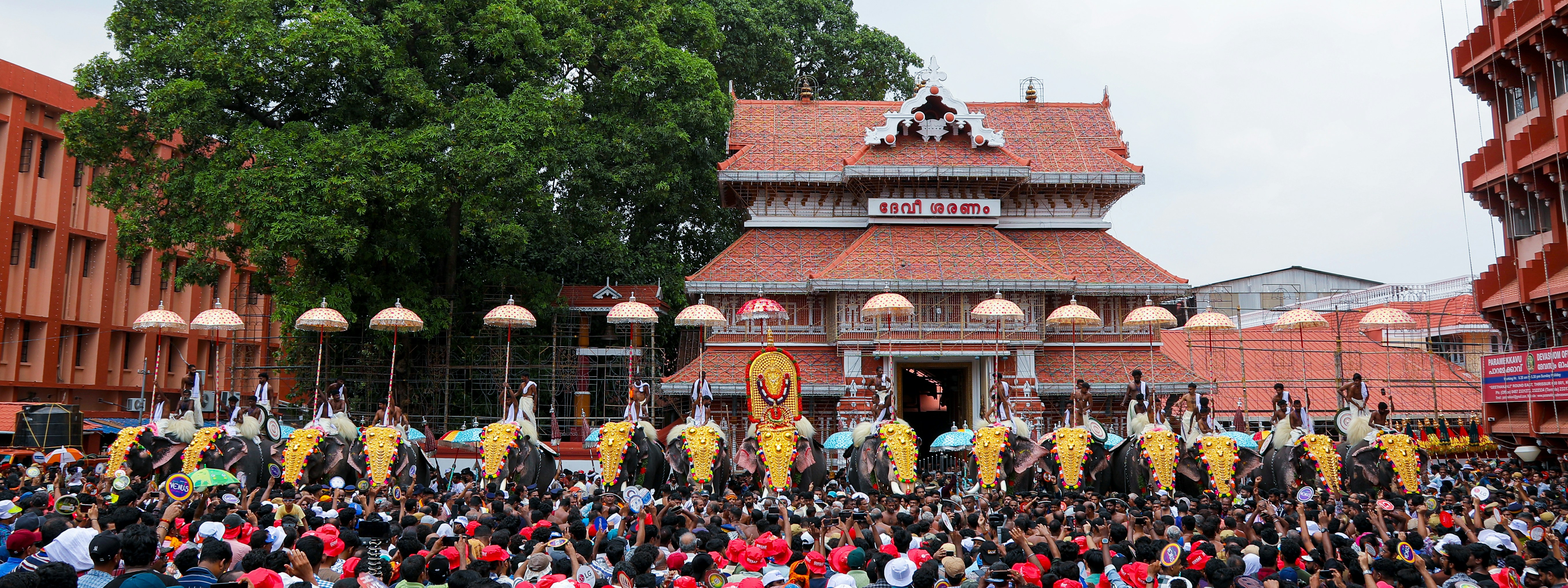
(Photo by Sageesh T Sathyan on Unsplash)
Every year, during the Malayalam month of Medam, the grounds of the Vadakkunnathan Temple in Kerala host the Thrissur Pooram. It is a week-long festival where deities from surrounding temples pay obeisance to Lord Shiva. The event is defined by elephant processions and rhythmic percussion. Yet, the soil upon which this festival takes place was once the staging ground for some of the darkest chapters in Kerala’s history.
In their historical narrative The Phoenix Rises: The Resurrection of Cochin, authors Raghu and Pushpa Palat reconstruct this era. The book tracks the journey of Shaktan Thampuran, the ruler of Cochin, providing a close-up look at the invasions of Malabar led by Hyder Ali and Tipu Sultan. Through Shaktan’s eyes, the destruction of sacred spaces becomes concrete; it happened to temples that still stand today.
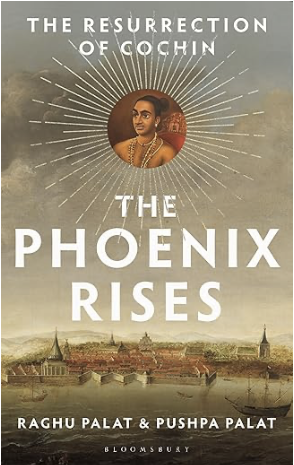
Born in 1751, Shaktan Thampuran entered a world of shrinking borders. The Kingdom of Cochin was teetering under pressure from the expanding powers of Travancore and Malabar, while the Dutch and the English meddled in local affairs. Recognizing his acumen, the Raja of Cochin entrusted the 18-year-old Shaktan with full administrative and sovereign authority. He had no army to speak of, no powerful allies, and two of the most dangerous men in 18th century India bearing down on his kingdom. What he had was the ability to read dangerous men and survive them.
Shaktan’s reign coincided with the Mysorean invasions. He had to navigate a path to preserve Cochin from annexation while witnessing the dismantling of the region’s socio-religious fabric.
The storm broke in 1766 when Hyder Ali marched into Malabar. The invasion was met with fierce resistance, epitomized by the Zamorin of Calicut, who locked himself inside his palace and set it ablaze rather than submit.
When rebellions later broke out among the Nair nobles, Hyder’s campaign shifted to retributive terror. He initiated forced conversions, desecrated temples, and plundered murtis to sell them in Coimbatore. By 1773, Hyder returned to subdue the Nair chiefs, stripping them of their right to bear arms and reducing their social standing. They were given the option to convert. Some did. Others fled to Travancore. Others preferred death.
During this period, a young Shaktan met Hyder Ali. Using diplomatic tact, Shaktan secured a fragile peace, even convincing Hyder to return certain disputed territories to Cochin.
Yet Hyder’s ultimate ambition remained the subjugation of Travancore. In late 1776, while America was declaring independence on a continent far away, Hyder dispatched 10,000 men under Sirdar Khan toward Travancore. When Cochin delayed paying the war expenses demanded by Mysore, Sirdar Khan’s army occupied territory up to Thrissur, camping on the grounds adjoining the Vadakkunnathan Temple. The priests locked the doors and fled. Though Sirdar Khan’s army routinely demolished temples, the Vadakkunnathan complex was spared. Hyder was soon occupied with a war against the English, and he died in 1782.
If Hyder Ali’s campaigns were driven by wealth, those of his son, Tipu Sultan, were fueled by ideological zeal. Convinced that the Hindu populace could not be trusted, Tipu concluded that the only way to secure Malabar was to enforce conversion to Islam.
In 1787, his campaign began. The jizya tax was imposed, and local leaders like Chorangattu Nair were publicly hanged for refusing to convert. Tipu took special interest in the conversion of Nambudiris. When many of them fled to Travancore, Tipu asked Dharmaraja, the king of Travancore, to return the refugees. When he received no response, Tipu decided to attack Travancore.
While camped in Palakkad, Tipu summoned the Raja of Cochin. Shaktan — who had previously avoided him — decided to meet in person. The 38-year-old Shaktan rode to Palakkad, where Tipu received him warmly and accepted his gifts. The conversation that followed was an exercise in verbal chess. Tipu pushed him to join the war against Travancore. Shaktan evaded the trap by stating he needed permission from the King of Cochin, promising instead to persuade the Raja of Travancore to become a vassal of Mysore. Tipu let him go.
Travancore did not surrender, prompting Tipu to launch a full rampage. In 1789, Tipu marched to Thrissur with 30,000 infantry and 5,000 cavalry. Temples and churches were plundered, and economic infrastructure, including markets and pepper vines, was destroyed. Some historians have called this march progressive, crediting Tipu with sparking social reform. Sandeep Balakrishna’s Tipu Sultan: The Tyrant of Mysore, which draws on primary sources, shows what that progressiveness actually looked like on the ground. Citing William Logan’s Malabar Manual, historian Gopalan Nair recorded the brutality of this march:
In March, 1789, a Mysorean force of 19,000 men with 46 field-pieces surrounded 2,000 Nayars with their families in an old fort at Kuttipuram… finding it untenable, they submitted to Tippu’s terms, which were a voluntary profession of the Muhammadan faith or a forcible conversion with deportation… the rite of circumcision was performed on all the males, every individual of both sexes being compelled to close the ceremony by eating beef.
The Guruvayoor temple lay directly in Tipu’s path. The priests hid the main deity in the temple pond and fled with the processional idol to the Ambalappuzha Sree Krishna Temple. Tipu set fire to the temple, but a sudden downpour doused the flames, prompting him to leave it alone.
Tipu then occupied Thrissur for a month, converting the Vadakkunnathan Temple into his administrative office and using the adjacent monastic mutts as officers’ quarters. His soldiers slaughtered cows and dumped their carcasses into the temple’s sacred wells. Many people died of hunger. Famine and disease followed the occupation.
Tipu finally met his match against the Travancore forces. As he was fighting the Travancore army in Aluva, news reached him that the English were attacking his capital. He rushed back to Mysore, and was killed at Srirangapatna in 1799.
Shaktan, who had used various techniques to placate both father and son, had seen their methods firsthand. The destruction caused to temples and churches led him to declare that Cochin would no longer remain a tributary of Mysore.
In 1798, temple processions from Thrissur traveled to the Arattupuzha Pooram — the premier festival of the time. Due to arrival delays caused by heavy rains, the local organizers barred them from participating, sending them back in humiliation. The aggrieved priests complained to Shaktan Thampuran. The Raja decided to counter this exclusion by creating a grander festival. The first Thrissur Pooram was conducted in 1799 — the same year Tipu Sultan was killed in battle.
Hyder and Tipu are gone, but the sacred places they targeted remain. The Guruvayoor temple is one of the most visited sites in Kerala, and the Vadakkunnathan Temple still stands at the center of Thrissur. Every year, the Thrissur Pooram is conducted with fervor on the very grounds Tipu once used as an office. The man who sat across from tyrants and survived them left behind not a legacy of warfare, but a festival.
