(This op-ed was published in Jan 25, 2009 edition of Mail Today/ PDF)
To commemorate the International Year of Astronomy in 2009, P Govinda Pillai, a Communist Party of India (Marxist) ideologue, in an article in the Malayalam newspaper Mathruboomi, examined the legacy of Copernicus, Galileo and Kepler. He also bought out an important topic – Eurocentrism in history writing – due to which we know about the work done on telescopes by Galileo, Hans Lippershey and Roger Bacon, but almost nothing by the Arab scientist al-Hassan.
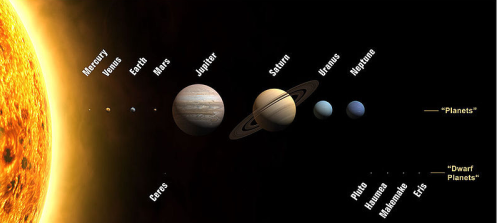
Mr. Pillai stopped there. He wrote nothing about the contributions of mathematicians and astronomers from his state, Kerala, in developing the heliocentric model and calculating planetary orbits. It is not Mr. Pillai alone who is at fault. This apathy, this ignorance, this refusal to acknowledge Indian contributions — all point to a deep malaise in our historical studies. For perspective on this issue, we need to understand the contributions of Indian astronomers and decide if we should be like Confucians during the time of the Ming dynasty or 21st century Peruvian archaeologists.
The Kerala School of Mathematics
In 1832, a paper, “On the Hindu quadrature of a circle”, was read at the Royal Asiatic Society. This paper by Charles M. Whish of the East Indian Company Civil Service described eight mathematical series quoting from a text called Tantra Sangraham (1500 CE) which he had discovered in Kerala. These series were also mentioned in Yukti Dipika by Sankara Variyar and Yukti-Bhasa by Jyestadevan; both those authors had learned mathematics and astronomy from Kellalur Nilakanta Somayaji, the author of Tantra Sangraham. Some of those series were linked to Madhavan of Sangramagramam (1340-1425 CE). These mathematicians who lived between the 14th and 16th centuries formed the Kerala School of Mathematics and were proof that Indian mathematics did not vanish after Bhaskaracharya.
The importance of the Kerala school can be appreciated only by understanding the Copernican revolution. The contribution of Copernicus was two fold: first he improved
the mathematics behind the Ptolemaic system and second, changed the model from geocentric to heliocentric. The heliocentric model was proposed as early as the third century BCE by the Greek astronomer Aristarchus of Samos and so it is the math that made the difference.
 In his Tantra Sangraham, Nilakanta revised the Indian planetary model for the interior planets, Mercury and Venus and for this he formulated equations to find the center of the planets better than both Islamic and European traditions. He also described the planetary motion in which Mercury, Venus, Mars, Jupiter and Saturn moved in eccentric orbits around the Sun, which in turn went around the Earth. Till Nilakanta, the Indian planetary theory had different rules for calculating latitudes for interior and exterior planets. Nilakanta provided a unified rule. The heliocentric model of Copernicus did not alter the computational scheme for interior planets; it would have to wait till Kepler (who wrote horoscopes to supplement his income).
In their propensity to solve astronomical problems, mathematicians of the Kerala school developed concepts like Gregory’s series and the Leibniz’s series. The hallmark of earlier texts, like those of Madhava, were instructions and results without proofs or explanations. It is believed that the proofs and explanations were passed orally and hence rarely recorded. Yuktibhasha, the text written by Jyesthadeva, contain proofs of the theorems and the derivations of the rules, making it a complete text of mathematical analysis and possibly the first calculus text.
Lessons from Peru
Our education system, based on content from Western textbooks, have rarely questioned Western accomplishments. But Peruvians thought differently. When Peruvian archaeologists revisited the history written by the victors they discovered that the romantic tales woven by the Conquistadors were – well, tales. According to the original story, Francisco Pizarro, a Spaniard arrived in Peru in 1532 with few hundred men. Few weeks after their arrival, in a surprise attack, they killed the Inca king Atahualpa and took Cusco, the Inca capital. Four years later the Inca rebellion attacked Cusco and the new city of Lima.
On August 10, 1536, while Copernicus and the Kerala school were revolutionizing the world of astronomy half a world away, Francisco Pizzaro watched as tens of thousands of Incas closed in on Lima. With just a few hundred troops, Pizzaro had to come up with a strategy for survival. The Spaniards lead a cavalry attack and first killed the Inca general and his captains. Devoid of leadership the Incas scattered and once again the Spaniards won.
Recent archaeological excavations found a different version of this story. Out of the many skeletons found in the grave near Lima, only three were found to be killed by Spanish weapons; the rest by Incas. A testimony by Incas who were present in the battle was found in the Archive of the Franciscans at the Convent of San Francisco de Lima, which mentioned that it was not a great battle, but just a few skirmishes. Pizzaro was helped by a large army of Indian allies and the battle was not between the Spaniards and Incas, but between two Inca groups. It was also found that size of rebels were not in tens of thousands, but in thousands and there was no cavalry charge.
Thanks to the work of native archaeologists dramatic accounts of a small band of heroic Europeans subduing the Incas has a new narrative.
Lessons from China
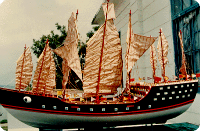 Instead of following such examples and popularizing the work of Indian mathematicians, we have been behaving like Confucians at the court of the 15th century Ming emperor Zhu Di who erased evidence of the large fleets that sailed as far as the Swahili coast. While the world knows about the accomplishments of Europeans like Vasco da Gama, Columbus, Magellan and Francis Drake, little is known about Zheng He who arrived in Calicut eighty years before da Gama commanding a fleet of three hundred ships carrying 28,000 men; Vasco da Gama arrived with three ships and less than two hundred men.
Between 1405 to 1433, Zheng He’s fleet made seven voyages —- three to India, one to Persian Gulf and three to the African coast — trading, transporting ambassadors, and establishing Chinese colonies. Following the death of the emperor who commissioned these voyages, the Confucians at the court gained influence. Confucius thought that foreign travel interfered with family obligations and Confucians wanted to curtail the ambitious sailors and the prosperous merchants.
So ships were let to rot in the port and the logs books and maps were destroyed. The construction of any ship with more than two masts was considered a capital offense. A major attempt at erasing a proud chapter in their history was done by the natives themselves.
Appreciating our stars
The goal is not to diminish the accomplishments of Copernicus or Galileo but to note that no less important accomplishments were achieved by the Kerala school either before or around the same time. Interestingly in the West, Copernican revolution was considered a movement into science to which the Church, obstinate in religious dogma, would take umbrage. In India no one was burned at the stake or put under house arrest for proposing a heliocentric model.
Instead of accepting the astronomical concepts of the Church on faith, Galileo investigated them and found new truths. Extrapolating that to historical studies we need to critically examine the Eurocentric history like the Peruvians and popularize the work of our ancestors. In this International year of astronomy, if we do not inform everyone about our great astronomers, who will ?
Postscript: In the midst of all this Eurocentric history, as a surprising exception to the norm, the only educational institution where one can take an elective course in The Pre-History of Calculus and Celestial Mechanics in Medieval Kerala is Canisius College, New York.
References: This credit for this article goes to Ranjith, a reader of this blog. He alerted me to Govinda Pillai’s article and then sent various research papers and articles about the Kerala School. He made me read Modification of the earlier Indian planetary theory by the Kerala astronomers, 500 years of Tantrasangraha, Madhavan, the father of analysis, Whish’s showroom revisited and The Pre-History of Calculus and Celestial Mechanics in Medieval Kerala.
Dick Teresi’s book Lost Discoveries, which I first read in 2003, covers the ancient roots of modern science and has sections on Indian mathematicians and astronomers. I remember buying The Crest of the Peacock
Finally, Rajiv Malhotra on Eurocentrism of Hegel, Marx, Mueller, Monier Williams, Husserl.
(images via wikipedia and indiaclub)
Tag: Indian History
King Agathocles's Coins
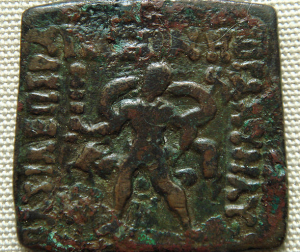 |
| (Balarama depicted on a 1st century BCE Maues coin. via wikipedia) |
Between 190 and 180 BCE, towards the end of the Mauryan empire, there lived a king named Agathocles near Ai-Khanoum, in the Kunduz area of Afghanistan. There are no cities, monuments or accounts about him and he would have remained unknown if not for one thing – coins.
Some time in the 70s, archaeologists found two types of coins issued by him. One set was Greek silver coins depicting Zeus and Dionysos. He also issued bronze and silver coins, square or rectangular in shape, which portryated Indian gods like Vishnu, Shiva, Vasudeva, Buddha and Balarama. On these coins were written, in Brahmi or Kharoshthi, that the money belonged to Rajane Agathuklayasa.
“These square coins, dating back to 180- BC, with Krishna on one side and Balram on the other, were unearthed recently in Al Khanoun in Afghanistan and are the earliest proof that Krishna was venerated as a god, and that the worship had spread beyond the Mathura region,” says T K V Rajan, archaeologist and founder-director, Indian Science Monitor, who is holding a five-day exhibition, In search of Lord Krishna,’ in the city from Saturday. [New finds take archaeologists closer to Krishna-Chennai-Cities-The Times of India]
The images show Vasudeva carrying a chakra and sankha on one side and Balarama carrying a gada (club) and hala (plough) and are some of the earliest coins depicting Krishna and Balarama. But these are not recent discoveries as mentioned in Times of India; a paper on it (Narain, A.K. “Two Hindu Divinities on the Coins of Agathocles from Ai-Khanum”, Journal of Numismatic Society of India) was published in 1973.
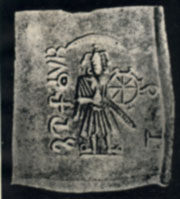
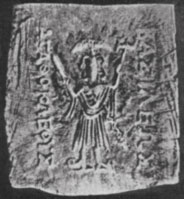
References:
- Alexander the Great and Bactria By Frank Lee Holt
- Iconography of Balarama By N.P. Joshi
Making of the Modern World
They have not discovered audio editing yet. Each lecture begins with three minutes of silence. At the end there are ten minutes of silence. Still UCSD Prof. Matthew Herbst’s lecture series MMW4 (New Ideas/Clash of Cultures) is the best history podcast I have listened so far.
These lectures are part of the Making of the Modern World Program at the Roosevelt College.
It is designed to encourage thinking historically, comparatively, and in an interdisciplinary way about the Western and non-Western cultures studied in the course sequence. Disciplinary perspectives include those from literature, history, philosophy, anthropology, sociology, political science, and the fine arts. Students examine and interpret primary documents and artifacts from diverse eras and cultures, and enhance their understanding with information gained from secondary sources. [Roosevelt College]
While most beginners in history start with the usual Western Civilization till 1500 course, which ignores India, China and the Muslim world, the MMW series is quite comprehensive. This particular one, going on in the Fall session, examines the world from 1200 to 1750 covering the Mongols, Mamluks, Mughal Empire, Ottomans, Saffavids, the Western explorers and China.
His lecture on the Mughal Empire would give a heart attack to some “eminent” Indian historians. After talking about Akbar, he contrasts him with Aurangzeb and explains how he destroyed the temple at Varanasi and built a mosque in place. Following this he explains the rise of Shivaji.
But that is not why MMW4 is great. His style of teaching history is exceptional. He does not read out the text book, but tells it like a story. At each point, he asks questions like why is this important or why a certain decision was taken instead of another? As you think, various patterns emerge and expands your mind.
The course is going on right now in San Diego and it is available for download or listening online. The UCSD folks have not discovered storage unlike the UC Berkeley folks and so the course will be deleted as soon as the Fall quarter ends. (mid December).
Lost & Found: Palm Leaf Manuscript penned by Swati Tirunal
Rare text of Swathi Thirunal found
The text, ‘Sandupuruvarnanam,’ describing the unique feature of erstwhile royal state of Travancore, was recently traced by manuscript researchers at Manoormadam Kottaram in Mavelikkara in Alappuzha district.
Out of the 57 palm leaves of this text penned by Swathi Thirunal in Malayalam script, 31 have been found among a bundle of manuscripts in a box at Manoormadam, Assistant Co-ordinator of Manuscripts Post-survey Programme, P L Shaji told PTI.
From the inscriptions on the text, it could be learnt that they were written in AD 1839, he said.
Megalithic Burrial Urns in Kerala
While the Harappans were known to burry the dead, in South India, there was this custom of burrying the dead in urns. In the past few years there were discoveries of burrial urns in various places in Tamil Nadu. Burrial urns, 2800 years old were found in Adichanallur with the urns having inscriptions in Tamil-Brahmi. Later urns dating from 3rd century BCE to 3rd century AD were found in Palani. This practice of burrying people in urns was common in ancient Greece as well as in Sri Lanka and Southeast Asia.
Now three types of burrial urns, believed to date back to between 6th century BCE and 2nd century AD have been found in Kaladi (Adi Shankara’s birth place) in Kerala.
The urns were excavated by a team of researchers led by B. Ramesh, Director of the Research Centre at Sree Sankara College in Kalady. “Three types of earthen urn burials and some pots were found in a single day’s excavation. Due to heavy downpour, the contents were severely affected. The biggest urn is 4.5 feet high and 2.75 ft in diameter,” Dr. Ramesh said.
He said that its lower half had a height of 2.75 ft. The height of the upper half cannot be ascertained due to the damage that has occurred to it over the years. This was found 2.5 feet beneath the surface. It is a handmade red-and-black ware having a shape similar to that of an egg, with an ovoid lid. A prominent rim is seen on the middle part that joins the two halves.
The second urn (a medium-sized) was 3 ft high and has an inner diameter of 1.5 ft. It was situated on the northeast side of the main urn and three feet beneath the ground level. It also has a lid similar to the big one. But the bottom portion is a flattened one.
The third urn, smaller in size, also was 2.75 ft away from the main urn. Small earthen plates in broken conditions are also seen near the urns. Dr. Ramesh said the research team had conducted similar excavations near the present site on the banks of the Periyar. The team had found tools of varying sizes and shapes belonging to the Neolithic period. Various black and red pots and pot shreds were also retrieved.
The research team is now trying to identify more sites in the area that bear the relics of ancient culture and civilisations. They have also started a project to collect evidence that mark the presence of such age-old remains dating back to the Neolithic and Megalithic periods.
Archaeologists say the burial urns found in Kalady indicate that a civilised society lived there more than 2,500 years ago and the excavation also reflects the typical south Indian megalithic culture. [Burial urns of Megalithic period excavated]
Hunting for Muziris – III
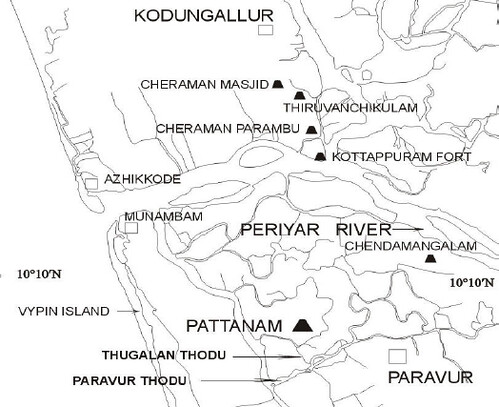
The BBC has an article on the theory that the town of Pattanam in Kerala could be the location of the ancient port of Muziris.
What is known, from a 1st Century document, is that the harbour was “exceptionally important for trade.”
Clues to its location are provided in ancient Indian texts. Professor Rajan Gerta, from Mahatma Gandhi University in Kerala, said that there are many references to “ships coming with gold, and going back with ‘black gold'” – pepper.
“These ships went back with a whole lot of pepper and various aromatic spices, collected from the forests,” he added. Merchants from a number of different cultures are believed to have operated in the port, and there are numerous Indian finds from the time as well as Roman ones.
In 1983, a large hoard of Roman coins was found at a site around six miles from Pattanam. However, even if Muziris has been found, one mystery remains – how it disappeared so completely in the first place.
Dr Tomba said that it has always been presumed that the flow of the trade between Rome and India lasted between the 1st Century BC through to the end of the 1st Century AD, but that there is growing evidence that this trade continued much longer, into the 6th and early 7th Century – although not necessarily continually. [Search for India’s ancient city via email from Srijith]
There is no new information in this article. Dr. Shajan has been in the news for suggesting the location of Muziris and has been covered in varnam here and here. Dr. Shajan and V. Selvakumar have a 47 page presentation on the new evidence on which they have formed this conclusion.
Note that the map shows the location of the Cheraman Perumal Masjid, which according to myth, was built by a Kerala king who converted to Islam.
(Image via Dr. Shajan)
Kerala's Jewish History
There are various theories on Kerala’s relation with the Jews. According to oral tradition Jews established trading contacts with Kerala during the time of Solomon. There are other traditions which claim that Jews came to Kerala during the time of King Nebuchadnezar of Babylon in 500 BC, the time of Buddha. According to Romila Thapar in her book Early India, the Jews came to India in the tenth and eleventh century AD.
The Jews of Cochin say that they came to Cranganore (south-west coast of India) after the destruction of the Temple in 70 C.E. They had, in effect, their own principality for many centuries until a chieftainship dispute broke out between two brothers in the 15th century. The dispute led neighboring princes to dispossess them. In 1524, the Moors, backed by the ruler of Calicut (today called Kozhikode) attacked the Jews of Cranganore on the pretext that they were “tampering” with the pepper trade. Most Jews fled to Cochin and went under the protection of the Hindu Raja there. He granted them a site for their own town that later acquired the name “Jew Town” (by which it is still known).
Unfortunately for the Jews of Cochin, the Portuguese occupied Cochin in this same period and indulged in persecution of the Jews until the Dutch displaced them in 1660. The Dutch Protestants were tolerant and the Jews prospered. In 1795 Cochin passed into the British sphere of influence. In the 19th century, Cochin Jews lived in the towns of Cochin, Ernakulam and Parur. Today most of Cochin’s Jews have emigrated (principally to Israel).[The Virtual Jewish History Tour]
Recently a reunion was held in the town of Chendamangalam by about 100 Jews to bless a synagonue built in 1614.
Among the ancient graves outside the synagogue, stand a tombstone which dates from 1264, making it the oldest Hebrew inscription found in India. The oldest such document is regarding a wedding that took place in the synagogue in 1812. [Kerala showcases its Jewish history, treasures]
Quiz – I
Question: Who wrote ‘Om Jai Jagdish Hare’?
Hint: He also wrote the first Hindi Novel in 1888
Answer: is here.
Raja Ravi Varma's Lithographs
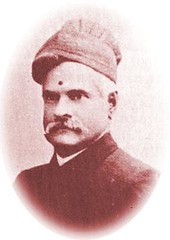
Raja Ravi Varma (1848-1906)
Raja Ravi Varma lived for a while in Maharashtra and painted many Maharashtrian women. He also ran a press in the town of Malavli. Two Italian curators Enrico Castelli and Giovanni Aprille visited the press few years back and found it in very bad condition.
“When we visited the press, we found rare paintings infested by moth and the owner was planning to sell it off. Even the Archaeological Survey of India did not want to do anything. So we decided to restore them,’’ says Castelli, who owns the Tamburo Parlante museum of African heritage. [Stoned for posterity]
These lithographs (engraving on stone), can be seen in at the exhibition titled Divine Lithography, organised at the Indira Gandhi National Centre for Culture and Arts in Delhi. The exhibition is also traveling to Trivandrum and Pune.
Recreating an ancient trade route
 According to Romila Thapar[3], the trade via the maritime route between the west coast of India and west Asia go back to the third millennium B.C. At that time the Egyptian civilization was in existence and Indus Valley was in its early stages. Once the trade route was established, there was continuous Indian presence in west Asia. This was the predecessor of the trade relations with Rome in the first millennium B.C and Africa in the first millennium A.D.
Georg Feuerstein et al[2] writes about cuneiform texts mentioning historical a historical place called Magan (or Makan) which according to some scholars could be Sudan or Ethiopia. But majority of the scholars think that Magan is present day Oman. Copper was found there as early as the fifth millennium B.C and and Omanis were wealthy from copper export. Copper attracted the merchants from the Indus valley and an inscription in Harappan script was found at Ras al-Junayz.
Now some researchers are traveling along that bronze age trade route, on a boat, similar to the one used by people four millennia back.
The 40-foot Magan, named after an ancient name for Oman, is made of reeds formed into bundles, lashed together with rope made from date palm fibers and covered with a woven mat coated with black bitumen or tar to make it waterproof. The vessel will be powered by a square-rigged sail made of tightly woven wool and maneuvered using two teak steering oars.
The plan is to leave Sur in Oman on Wednesday, taking advantage of the last of the southwest monsoon winds and favorable currents, and sail east 590 miles to the historic port of Mandvi in Gujarat, India, a journey that could take up to three weeks.[Bronze Age-style reed boat to sail from Oman to India]
This is going to be one hell of a trip since the boat is not covered and the sails have to be adjusted constantly. The crazy people who are doing this, all eight of them want to know how life was back then, how boats were built and ancient navigation techniques. To add authenticity, they have cargo similar to the ancient ones and the menu consists of a typical bronze age meal.
Even maneuvering aboard will be hard, since crew members will be walking on cargo piled up in the bottom. The cargo is meant to be representative of trade goods of the period: copper ingots for making the bronze that gave the age its name, blocks of fine black diorite stone for carving, turtle and marine shells, pearls, frankincense, carved soapstone vessels, dates and date products, fish oil and sharkskin – an ancient sandpaper.
The crew consists of Vosmer and the navigator, both Americans; a sailing master from Australia; two Omani seamen; two Italian graduate students; and an Indian archaeologist. They will have a Bronze Age diet of dates, honey, legumes, dried fish, bread and water, but there will also be some modern munchies.
But unlike the bronze age travellers, Magan will have a GPS, navigation lights, emergence beacon and life jackets, and also an Indian naval vessel will be following it.
Update (Sept 8, 2005): The boat sinks
Update 2(Sept 11, 2005): There is going to be another boat (via Secular-Right India)