How old are our mantras?

The Michael Wood documentary, The Story of India, which was telecast in six parts on PBS mentioned something interesting in the very first episode. Wood talked about the Out of Africa theory – the migration of humans 70,000 years back, from Africa along the shores of Arabian Sea into South India – and mentioned that all non-Africans in the world are descendents of these Indians. Nothing new in that.

Going in search of clues left by those ancient migrants in South India, he arrived at the house of a Kerala brahmin who is teaching his son mantras the way it has been done for millenia. Wood then shows the 2006 athirathram – a 12 day vedic ceremony – and mentions that certain sounds recited in this ceremony takes years to learn but have no meaning. When brahmins were asked for meaning, they did not know. They simply knew that it was handed down.
Since man is a speaking animal, we have always assumed that any word man says is in language, but some of those mantras are not in any known language. Hence these sounds, which are still recited today, are considered to have evolved before human speech.
Of Birds and Humans
Frits Staal of UC Berkeley  thought that the claim that mantras are older than language was “preposterous.” In 1975 he helped finance an athirathram, which had not been conducted since 1956 due to financial constraints. Analyzing the sounds he came to the conclusion that mantras could belong to a pre-language era since:

  • Mantras are language independent: Anything in language can be translated whereas mantras remain the same in all languages.
  • Mantras, even though they seem to be in a language like Sanskrit, are not used for their meaning.
  • Mantras follow patterns, like refrain, which is not seen in language.

The clincher for the pre-language theory came when the sound patterns were analyzed to find the nearest equivalent in nature. The technique followed was like this: He took a mantra like Jaimintya Gramageyagana (45.2.1) which goes:

vo no ha bu / idam idam pura ha bu / pra va pra
vas ia ia ha yi / nina ninava tarn u vo ha bu / stiisa vi
sakhtaia Ya ha vi / dramutalyayi / o vi la /

It was split into patterns like AB / CB / DE/.. where A = vo no and B = ha bu. Comparing it to bird songs, it was found that the patterns were similar and such patterns were not found any where else.
As a side effect, by comparing the patterns of mantras and certain birds, it is possible to find which birds influenced the mantras. There is research which found patterns in the composition of Igor Stravinsky and a bird usually found in the region where he worked. Thus some of the mantra sounds were found to be inspired by the songs of Blyth’s Reed Warbler and Whitethroat – two birds which migrate to India.
There are examples of bird-human interaction in Vedas and Upanishads. Some vedic chools have been named after birds — like kausika after the owl or taittiriya after the partridge. D. D. Kosambi believed that Vedic clans were totemic. Then there is the story of Satyakama Jabala in Chandogya Upanishad who:
Text not available
Critiques
Having established this similarity between bird song and mantra, the theory then takes off with a life of its own. There are vedic rituals for making rain and curing illness and similarly birds sing for building nests or attracting females; there are rituals and bird songs for various occasions. Then it was also found that bird sing – believe it or not – just for pleasure. So Staal extends the theory to say that, similar to skiing, dancing and music, mantras and rituals too are done for pleasure.
Between Staal’s athirathram in 1975 and Wood’s in 2006, one was held in 1990 near Thrissur which I attended  for a day. This athirathram, which was extensively covered in Malayalam newspapers, was highly respectful and the words I heard were not “playful” or “pleasurable.” I can understand singing for pleasure, but am yet to meet a priest who said, “it’s a weekend and raining outside, let’s do a ganapati homam for pleasure.”
Prof. Staal thinks that not just the sounds, but rituals too are meaningless. But Wood writes that mantras, “work on emotions, the physiology, and the nervous system.” According to Wood, these rituals are a away of achieving heightened mental and physical state. So I am not sure if this research is of the Ganesha phallus quality. If you have seen any paper or book by anyone else, please leave a comment.
Postscript: Kosambi’s concept that Vedic clans were named after animals was criticized inThe Early Brahmanical System of Gotra and Pravara (Purusottama Pandita, John Brough). They wrote that it is equivalent to saying an Englishman with the surname Fox belongs to a totemic clan of that animal.  Instead they suggest that the bird name could have come from the clan name.

Reference:
Michael Wood has a companion book to the program. More details can be found in Staal’s paper, Mantras and Bird Songs, in which one quoted sentence reads: “there are mechanisms in existence which reinforce economical perfection in motor skills independently of the attainment of the ultimate biological goal in whose pursuit the learned movement is developed.” Staal’s book on this topic is available in limited preview mode in Google Books.

[serialposts]

The Kerala School and Lord of Guruvayoor

All Malayalees know Melpathur Narayana Bhattithiri (1559-1632 ) and his famous composition — Narayaneeyam — still sung in Guruvayoor temple. The immediate story that comes to mind is his tiff with his contemporary Poonthanam, whose judge turned out to be Guruvayoorappan
While Melpathur was composing Narayaneeyam in Sanskrit, Poonthanam was writing Jnanapana in Malayalam. This was a time when Malayalam was considered inferior to Sanskrit. When Poonthanam went to show his poem to Melpathur, he refused to see it; treating him like a groundling, Melpathur asked Poonthanam to learn Sanskrit.
The next day, Melpathur came to sing ten slokas of Narayaneeyam before Guruvayoorappan and he met a boy who found many mistakes in his composition. The boy vanished and a celestial voice announced, “Poonthanam’s bhakthi (devotion) is more pleasing to me than Melpathur’s vibhakthi (learning or knowledge in Sanskrit grammar)”.
So goes the legend.
Is there any truth to this story or is it something which which was written to show that Malayalam was as good as Sanskrit? Would a Sanskrit scholar like Melpathur make mistakes in his composition.? What we know is two pieces of information about Melpathur from which we will have to deduce information.
While Narayaneeyam is Melpathur’s most famous composition, he also wrote sreepaada saptati in praise of Bhagavathi, Manameyodayam on Mimamsa, and Kriyakramam on nambudiri rituals. Less known is the fact that Melpathur was connected to the Kerala school of mathematics. Melpathur was the student of Achyuta Pisharati (c. 1550-1621) who was the student of Jyestadeva, the author of yuktibhasha. Melpathur is not know for astronomical models or mathematical proofs but, according to Wikipedia, for Prkriya-sarvawom, which sets forth an axiomatic system elaborating on the classical system of Panini. This is believed to be written in sixty days[1].

Kerala School of Mathematics(teachers and students)

So would a person, who understood Panini, be sloppy with his work? Maybe. Sreedhara Menon, in his Survey of Kerala History, writes about Revathi Pattathanam, an annual assembly of scholars held in Calicut. Those who displayed exceptional knowledge in debates were awarded the title Bhatta. Melpathur was denied the Bhatta title six times before he won it eventually[1].
There is little information about Poonthanam’s later life, but much more about Melpathur and his royal patrons. But we don’t know anything Melpathur’s first drafts of Narayaneeyam and so it is hard to pin down the narrative historically.
Though Poonthanam’s Jnanappana too is still sung in houses in Kerala, the title of father of Malayalam goes to Thunchatthu Ezhutachan — a contemporary of Poonthanam and Melpathur — who translated Ramayana, and Mahabharata and standardized the Malayalam alphabet [2].
References:
[1] A Sreedhara Menon, A Survey of Kerala History
[2] S. Ramanath Aiyar, A Brief Sketch of Travancore, the Model State of India

History of Harivarasanam

That is a video of Yesudas singing one of the most famous Ayyappa songs – Harivarasanam – in his divine voice. This devotional song is sung every night and is Ayyappa’s lullaby. The Hindu blog has the history of the song.

This divine song which drenches the eyes of Ayyappa devotees in tears was written Kumbakudi Kulathur Iyer. Harivarasanam lyrics were composed in 1950. Kumbakudi Kulathur Iyer used to sing it daily when the temple doors were closed after performing the Athazapuja — serving the last meal of the day to Ayyappa. Today it is known as the Urakku Pattu — or the song that sends Ayyappa to sleep.
In the beginning, the main priest used to play flute while closing the doors of the temple. Harivarasanam became the Urakku Pattu of Ayyappa after the infamous fire incident in the 50s, which burn down the old temple. When the new temple was built and the pujas commenced, Harivarasanam was inducted as the Urakku Pattu — the song to send Ayyappa to sleep.[Who is the author of Harivarasanam?]

The e-Anjali newsletter of Kerala Hindus of North America has more details.

The ashtakam (8 stanza song) was first rendered at Sabarimala in 1955 by Swami Vimochanananda. In those days, only a few ardent devotees managed the difficult pilgrimage to Sabarimala in the deep jungles. The temple remained open during the November to January season but otherwise only on the first day of every Malayalam month. One Sri VR Gopala Menon from Alapuzha used to accompany the Melshanthi (head priest) Thirumeni Eashwaran Namboothiri to the Sannidhanam, and he would often stay there by himself in a shack even when the temple was closed, undisturbed by the wild animals, and often even feeding some animals. He used to sing Harivarasanam as the “urakkupaattu” (lullaby) for ayyappa swami at night. Later, when the Devaswom Board was formed, some say that he was asked to move out and he eventually passed away at a tea estate at Vandipperiyar.
When Thirumeni Eashwaran Namboothiri heard about the passing of the ardent bhaktha, he was deeply saddened. At the end of the day’s rituals, thirumeni was about to close Sannidhanam doors when he remembered the dedication and sacrifice of the bhaktha and he began to recite “Harivarasanam,” starting a tradition that remains unbroken to this day.

Lost & Found: Palm Leaf Manuscript penned by Swati Tirunal

Rare text of Swathi Thirunal found

The text, ‘Sandupuruvarnanam,’ describing the unique feature of erstwhile royal state of Travancore, was recently traced by manuscript researchers at Manoormadam Kottaram in Mavelikkara in Alappuzha district.
Out of the 57 palm leaves of this text penned by Swathi Thirunal in Malayalam script, 31 have been found among a bundle of manuscripts in a box at Manoormadam, Assistant Co-ordinator of Manuscripts Post-survey Programme, P L Shaji told PTI.
From the inscriptions on the text, it could be learnt that they were written in AD 1839, he said.

Megalithic Burrial Urns in Kerala

While the Harappans were known to burry the dead, in South India, there was this custom of burrying the dead in urns. In the past few years there were discoveries of burrial urns in various places in Tamil Nadu. Burrial urns, 2800 years old were found in Adichanallur with the urns having inscriptions in Tamil-Brahmi. Later urns dating from 3rd century BCE to 3rd century AD were found in Palani.  This practice of burrying people in urns was common in ancient Greece as well as in Sri Lanka and Southeast Asia.

Now three types of burrial urns, believed to date back to between 6th century BCE and 2nd century AD have been found in Kaladi (Adi Shankara’s birth place) in Kerala.

The urns were excavated by a team of researchers led by B. Ramesh, Director of the Research Centre at Sree Sankara College in Kalady. “Three types of earthen urn burials and some pots were found in a single day’s excavation. Due to heavy downpour, the contents were severely affected. The biggest urn is 4.5 feet high and 2.75 ft in diameter,” Dr. Ramesh said.

He said that its lower half had a height of 2.75 ft. The height of the upper half cannot be ascertained due to the damage that has occurred to it over the years. This was found 2.5 feet beneath the surface. It is a handmade red-and-black ware having a shape similar to that of an egg, with an ovoid lid. A prominent rim is seen on the middle part that joins the two halves.

The second urn (a medium-sized) was 3 ft high and has an inner diameter of 1.5 ft. It was situated on the northeast side of the main urn and three feet beneath the ground level. It also has a lid similar to the big one. But the bottom portion is a flattened one.

The third urn, smaller in size, also was 2.75 ft away from the main urn. Small earthen plates in broken conditions are also seen near the urns. Dr. Ramesh said the research team had conducted similar excavations near the present site on the banks of the Periyar. The team had found tools of varying sizes and shapes belonging to the Neolithic period. Various black and red pots and pot shreds were also retrieved.

The research team is now trying to identify more sites in the area that bear the relics of ancient culture and civilisations. They have also started a project to collect evidence that mark the presence of such age-old remains dating back to the Neolithic and Megalithic periods.

Archaeologists say the burial urns found in Kalady indicate that a civilised society lived there more than 2,500 years ago and the excavation also reflects the typical south Indian megalithic culture. [Burial urns of Megalithic period excavated]

Hunting for Muziris – III

pattanam
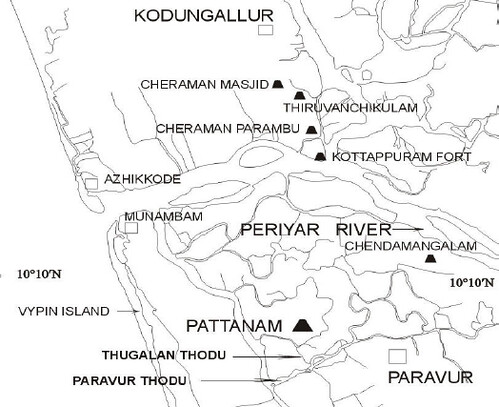
The BBC has an article on the theory that the town of Pattanam in Kerala could be the location of the ancient port of Muziris.

What is known, from a 1st Century document, is that the harbour was “exceptionally important for trade.”
Clues to its location are provided in ancient Indian texts. Professor Rajan Gerta, from Mahatma Gandhi University in Kerala, said that there are many references to “ships coming with gold, and going back with ‘black gold'” – pepper.
“These ships went back with a whole lot of pepper and various aromatic spices, collected from the forests,” he added. Merchants from a number of different cultures are believed to have operated in the port, and there are numerous Indian finds from the time as well as Roman ones.
In 1983, a large hoard of Roman coins was found at a site around six miles from Pattanam. However, even if Muziris has been found, one mystery remains – how it disappeared so completely in the first place.
Dr Tomba said that it has always been presumed that the flow of the trade between Rome and India lasted between the 1st Century BC through to the end of the 1st Century AD, but that there is growing evidence that this trade continued much longer, into the 6th and early 7th Century – although not necessarily continually. [Search for India’s ancient city via email from Srijith]

There is no new information in this article. Dr. Shajan has been in the news for suggesting the location of Muziris and has been covered in varnam here and here. Dr. Shajan and V. Selvakumar have a 47 page presentation on the new evidence on which they have formed this conclusion.
Note that the map shows the location of the Cheraman Perumal Masjid, which according to myth, was built by a Kerala king who converted to Islam.
(Image via Dr. Shajan)

Kerala's Jewish History

There are various theories on Kerala’s relation with the Jews. According to oral tradition Jews established trading contacts with Kerala during the time of Solomon. There are other traditions which claim that Jews came to Kerala during the time of King Nebuchadnezar of Babylon in 500 BC, the time of Buddha. According to Romila Thapar in her book Early India, the Jews came to India in the tenth and eleventh century AD.

The Jews of Cochin say that they came to Cranganore (south-west coast of India) after the destruction of the Temple in 70 C.E. They had, in effect, their own principality for many centuries until a chieftainship dispute broke out between two brothers in the 15th century. The dispute led neighboring princes to dispossess them. In 1524, the Moors, backed by the ruler of Calicut (today called Kozhikode) attacked the Jews of Cranganore on the pretext that they were “tampering” with the pepper trade. Most Jews fled to Cochin and went under the protection of the Hindu Raja there. He granted them a site for their own town that later acquired the name “Jew Town” (by which it is still known).
Unfortunately for the Jews of Cochin, the Portuguese occupied Cochin in this same period and indulged in persecution of the Jews until the Dutch displaced them in 1660. The Dutch Protestants were tolerant and the Jews prospered. In 1795 Cochin passed into the British sphere of influence. In the 19th century, Cochin Jews lived in the towns of Cochin, Ernakulam and Parur. Today most of Cochin’s Jews have emigrated (principally to Israel).[The Virtual Jewish History Tour]

Recently a reunion was held in the town of Chendamangalam by about 100 Jews to bless a synagonue built in 1614.

Among the ancient graves outside the synagogue, stand a tombstone which dates from 1264, making it the oldest Hebrew inscription found in India. The oldest such document is regarding a wedding that took place in the synagogue in 1812. [Kerala showcases its Jewish history, treasures]

Raja Ravi Varma's Lithographs

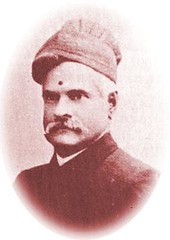
Raja Ravi Varma (1848-1906)

Raja Ravi Varma lived for a while in Maharashtra and painted many Maharashtrian women. He also ran a press in the town of Malavli. Two Italian curators Enrico Castelli and Giovanni Aprille visited the press few years back and found it in very bad condition.

“When we visited the press, we found rare paintings infested by moth and the owner was planning to sell it off. Even the Archaeological Survey of India did not want to do anything. So we decided to restore them,’’ says Castelli, who owns the Tamburo Parlante museum of African heritage. [Stoned for posterity]

These lithographs (engraving on stone), can be seen in at the exhibition titled Divine Lithography, organised at the Indira Gandhi National Centre for Culture and Arts in Delhi. The exhibition is also traveling to Trivandrum and Pune.

The myth of Cheraman Perumal's conversion

Recently, The President of India, Dr. A P J Abdul Kalam visited the Cheraman Juma Musjid in Kodungallur (ancient Muziris) in Kerala. This mosque, believed to have been built by Malik bin Dinar in 629 AD, is considered to be the oldest mosque in India. If this date is accurate, then this mosque was established much before the time of Adi Shankara (if we go by the dates ascribed by the Sringeri Peetam) and around the same time Huen Tsang was in India. This mosque has quite a history

As the tradition goes, a Chera king, Cheramanperumal of Kodungallure, left for Makkah, embraced Islam, and accepted the name Thajudeen. He married the sister of then King of Jeddah. On his return trip, accompanied by many Islamic religious leaders, led by Malik-ibn-Dinar (RA), he fell sick and passed away. But he had given introductory letters for the team to proceed to ‘Musiris’ (Kodungallur, the Chera capital. The visitors came to Musiris and handed over the latter to the reigning king, who treated the guests with all respect and extended facilities to establish their faith in the land. The king also organised help for the artisans to build the first Mosque at Kodungallur, by converting Arathali temple into a Juma-Masjid. It was build in 629 A.C., and the area around it had been ear-marked for the team’s settlement.[Cheraman Juma Masjid A Secular Heritage]

This story seems to be a myth propagated in the book Keralolpathi (The origin of Kerala) and repeated many times over. None of the reputed history books[1] mention this story, even the ones by eminent historians[3]. According to Sreedhara Menon[9]

The Cheraman legend is not corroborated by any contemporary record or evidence. None of the early or medieval travelers who visited Kerala has referred to it in their records. Thus Sulaiman, Al Biruni, Benjamin of Tuleda, Al Kazwini, Marco Polo, Friar Odoric, Friar Jordanus, Ibn Babuta, Abdur Razzak, Nicolo-Conti – none of these travelers speaks of the story of the Cheraman’s alleged conversion to Islam.

A mention of the Cheraman Perumal legend appeared in the 16th century book Tuhafat-ul Mujahidin by Shaik Zainuddin, but he too did not believe in its historical authenticity. But later cut and paste historians seem to have forgot to add his disclaimer.
Sreedhara Menon also authoritatively states that Kerala never had a king called Cheraman Perumal and quotes Dr. Herman Gundert, the German who composed the first Malayalam-English dictionary and the grandfather of Herman Hesse for this. But there seems to have been a Cheraman Perumal, whose history is overlaid by legend. According to Saiva tradition, he had an association with a Sundaramurti, the last of the three hymnists of Devaram. This Cheraman Perumal vanished in 825 A.D, about 200 years after Muhammed thus confirming that all that Mecca trip was a fanciful legend.[10]
Update (Jan 1, 2009): Maddy has detailed post about this episode

Footnotes:


[1] Picture of the old mosque and the renovated one
[2] India Archaeology Messages 2112, 2123

Kunhali Marakkar – a myth ?

For Malayalis Kunhali Marakkar was the brave commander of the Zamorin’s Navy, who fought against the Portuguese. The story is that the Muslim Marakkar dynasty fought against the Europeans for almost hundred years. But now there is new research suggesting that a) Marikkars were not of Arab descent, but instead were of Tamil origin b) he could be a myth

According to Dr. Ochanthuruth, “the traditional view of Kunhalis as patriots supporting feudal lords like the Zamorin needs to be corrected.
In the light of Kunhali Marikkar’s own actions and Shayk Zaynuddin’s statements, it is clear that they wanted an Islamic Principality in their own Malabar. (Shayk Zaynuddin was an Arab scholar who lived in Ponnani).
“After 1600 when the Kunhalis were almost silenced by the Zamorin through a political operation with the help of the Portuguese, the Muslim religious leaders in Malabar elevated Kunhali Marikkar as a cult figure for having attempted to unite the Muslims belonging to different ethnic groups and established their identity on the basis of an Islamic dream as visualised by Shayk Zaynuddin.
“This is the starting point of Muslim fundamentalism and communalism in South Malabar, later described by Ines and Evans as “fanatic zone,” he says in his paper presented at an international seminar on `The Portuguese and Kunhali Marikkars – myth and reality’.
“My attempt in this paper is to trace the truth about the origins, growth and struggles of the Marikkar family. Most of the Portuguese sources treat the Marikkar as enemies. Shayk Zaynuddin, an Arab scholar of Ponnani, in his Tuhfat-ul Mujahidin, states that the Marikkars had turned against the Portuguese only by 1524.
According to Dr. Ochanthuruth there is a big gap in historiographical literature about Kunhali Marikkar from 16th to the present century. Till the publication of Malabar and the Portuguese in 1929 by Sardar K.M. Panikkar, there was no serious writing on the Kunhali Marikkars except a few ballads.
Dr. Ochanthuruth’s views contradict the opinions of well-known and highly rated historians Sardar K.M. Panikkar, A.V. Krishna Ayyar and O.K. Nambiar.
He also questions claims that Marikkars were Mappila Muslims (Mappilas are children of Arabs married to Malabar women), and contends there is no evidence to support the belief that Marikkars lived in Pantalayani – Kollam, then in Tikkodi and then in Kottakkal, which was their last headquarters.
“Available evidence suggests Marikkars were of Tamil origin and many of them were Parathava converts from Coramandel,” Dr. Ochanthuruth claimed. [Kunhali Marikkars: myth and reality]